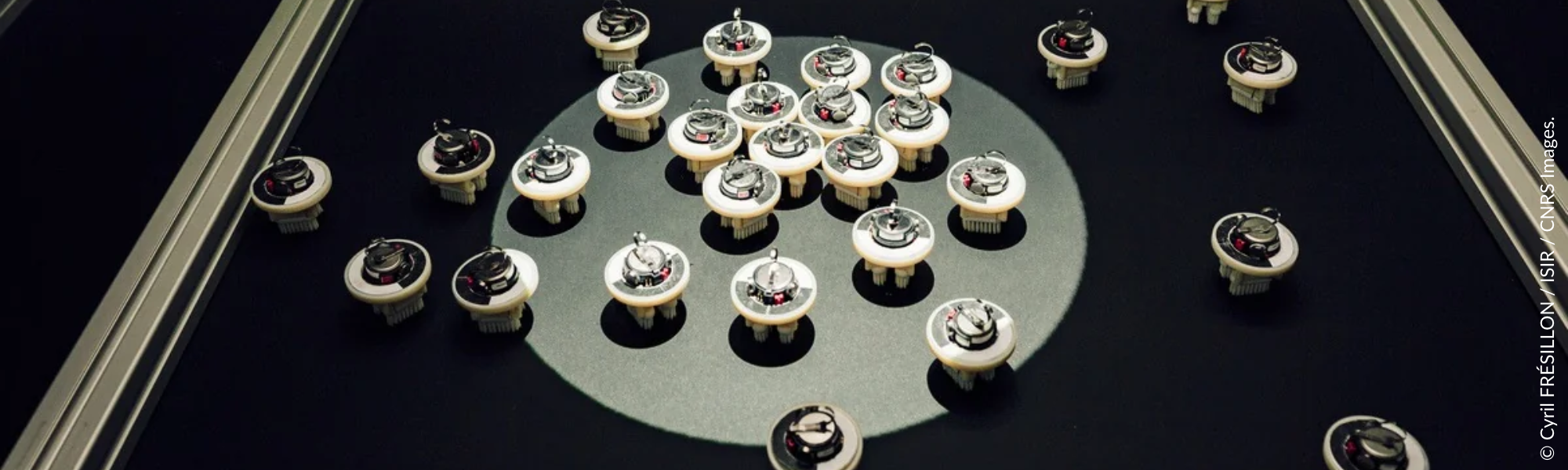
Inspired by physics and the natural world, researchers have demonstrated that a swarm of small robots can recognise the shape of the space in which they operate, without cameras, maps or knowledge of their own positions. This breakthrough in collective robotics has been driven in particular by ISIR at Sorbonne University.
How can a group of robots understand the shape of its environment when none of them has an overall view of it? This is the challenge addressed by the research project “Hearing the shape of an arena with spectral swarm robotics”.
Bringing together robotics, biophysics and mathematics, this project explores an original idea: enabling robots to recognise the geometry of a space simply by exchanging information with their neighbours. This approach allows collective perception to emerge from local interactions, without the need for complex equipment.
Overcoming the limitations of individual perception
Swarm robotics draws direct inspiration from nature. Much like ants working together to find food or fish moving in schools, it aims to enable large groups of simple robots to perform complex tasks through basic behavioural rules.
In recent years, research has shown that swarms can coordinate their movements and adopt collective formations. However, one major challenge remains: how can these robots understand the environment in which they operate?
The problem is similar to the parable of the blind men and the elephant: each individual can perceive only one part of the animal and cannot reconstruct its overall shape on their own. The same applies to a robotic swarm. Each robot can only detect its immediate neighbours. It does not necessarily know its own position and has neither a map of the environment nor an overall view of the space. Furthermore, these small machines have limited computing power, memory and communication capabilities.
Conventional mapping techniques, which require sophisticated sensors and substantial computational resources, are therefore poorly suited to these systems. The challenge is to enable the collective to perceive something that no individual robot can observe on its own.
Hearing the shape rather than seeing it
To address this challenge, the researchers drew inspiration from a famous question posed by physicist Mark Kac in 1966: “Can one hear the shape of a drum?” This question, rooted in mathematical physics, explores whether the characteristics of a drum’s vibrations can reveal the shape of its membrane.
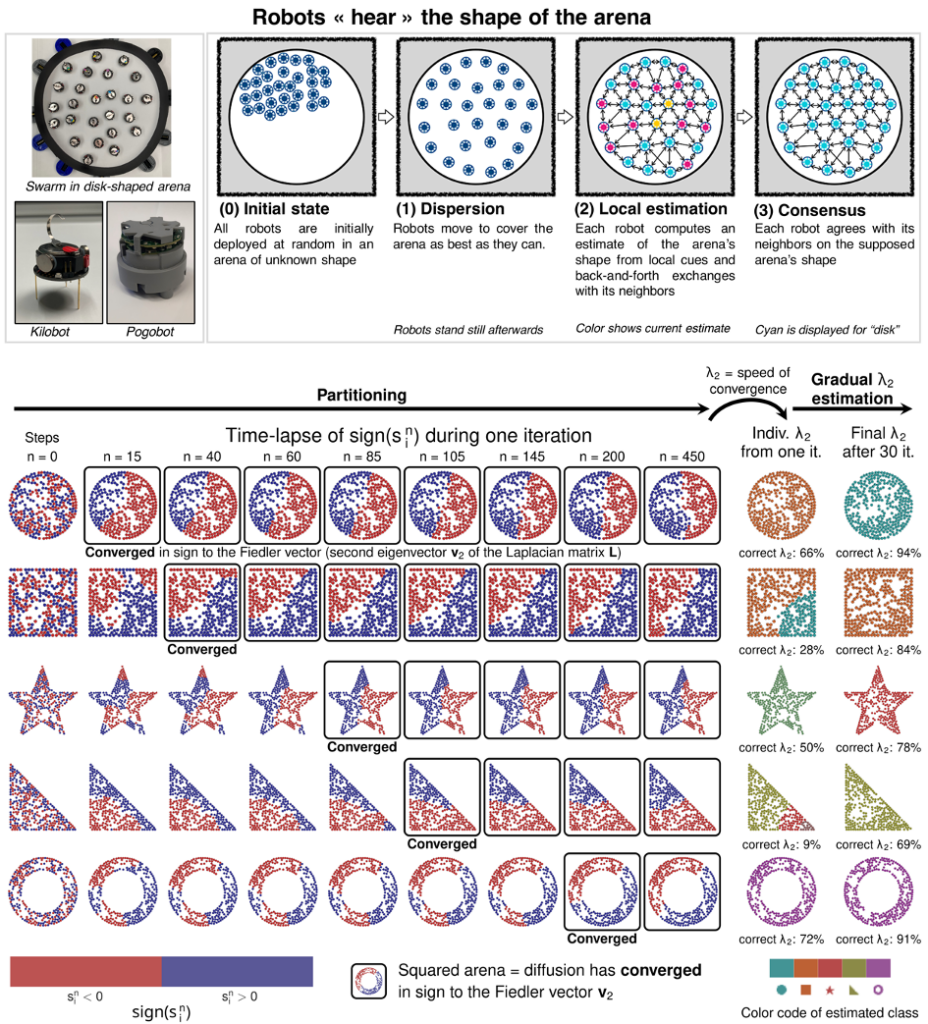
The project applies this idea to swarm robotics. Rather than directly observing the boundaries of a space, the robots exploit the way information spreads through their communication network. In practice, each robot exchanges numerical values with its neighbours. These values evolve according to a mechanism similar to heat diffusion: when one area is “warmer” than another, the difference gradually decreases.
However, the rate at which these values equalise depends on the geometry of the space. Narrow passages, boundaries and obstacles affect interactions between robots and therefore influence how information flows throughout the swarm.
By analysing this process, the collective obtains a kind of mathematical fingerprint of its environment. This signature can then be compared with reference patterns to recognise a known shape. In other words, the robots do not directly observe the geometry of their surroundings: they perceive it through the way they exchange information. What makes this approach original is that the communication network itself becomes a tool for collective perception and computation.
Promising results, both in simulation and with real robots
The researchers have demonstrated the effectiveness of this method through several experiments. In simulation, the approach successfully distinguished seven different shapes, using swarms of up to 550 robots. The method was also tested on two types of real robotic platforms: Kilobots and Pogobots. These small robots make it possible to study collective behaviours through local interactions in real-world conditions. In one experiment, a swarm of 25 Pogobots successfully identified whether the enclosure in which it was operating was shaped like a disc or a ring. Recognition took approximately five minutes per trial, across 30 trials.
Beyond this demonstration, the research established a relationship between three key parameters: the number of robots, their communication range and the area to be covered. These findings help determine the most favourable configurations for enabling a swarm to identify its environment. Above all, they show that global information about geometry can be reconstructed through local exchanges and relatively simple computations, without precise positioning or centralised mapping.
Future research could focus on identifying more complex geometries, detecting cavities or boundaries, and extending this collective perception approach to moving swarms. Ultimately, robots could use the information they gather to adapt their own organisation: changing their distribution across a space, adjusting their formation or navigating around obstacles more effectively.
This work therefore contributes to an important development in collective robotics: moving from swarms capable of cooperating locally to swarms capable of understanding certain global properties of their environment.
An interdisciplinary collaboration led by ISIR
This project brings together several scientific disciplines. It combines biophysics, drawing on research conducted at the University of Tokyo and the Jean Perrin Laboratory at Sorbonne University; mathematics, with contributions from Jean Monnet University Saint-Étienne; and swarm robotics, through the Institute of Intelligent Systems and Robotics (ISIR) at Sorbonne University, the project’s lead partner, under the direction of Nicolas Bredeche.
The research was conducted by Léo Cazenille (postdoctoral researcher), Nicolas Bredeche (Professor), Alessia Loi (PhD student) and Loona Macabre (PhD student). Their findings were published in the scientific journal Science Robotics under the title “Hearing the shape of an arena with spectral swarm robotics”.
This research has also paved the way for further scientific developments, inspiring two ongoing PhD projects, a postdoctoral research position and a project funded by the French National Research Agency (ANR).
Official link to the Science Robotics article: https://www.science.org/doi/10.1126/scirobotics.adr9578
Link to the full text of the article on arXiv: https://arxiv.org/abs/2403.17147 or on HAL: https://hal.science/hal-04526436/file/article.pdf
Scientific contacts: Leo Cazenille, postdoctoral researcher, and Nicolas Bredeche, university professor
Published on 16/11/2026