
Project: “Advanced Methods for the Assistance to the Gesture in gastro-Endoscopic Interventions”
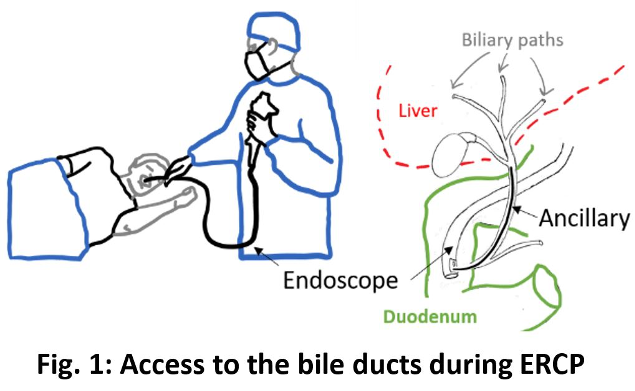
Endoscopic retrograde cholangiopancreatography (ERCP) is a procedure primarily used to treat conditions of the biliary tract. It is a complex, minimally invasive procedure that utilizes X-ray imaging and passive catheterization instruments (Fig. 1). The complexity of the biliary tree, the reliance on indirect 2D visual feedback, and the lack of navigational capabilities in the instruments used represent the primary limitations of ERCP.
The context
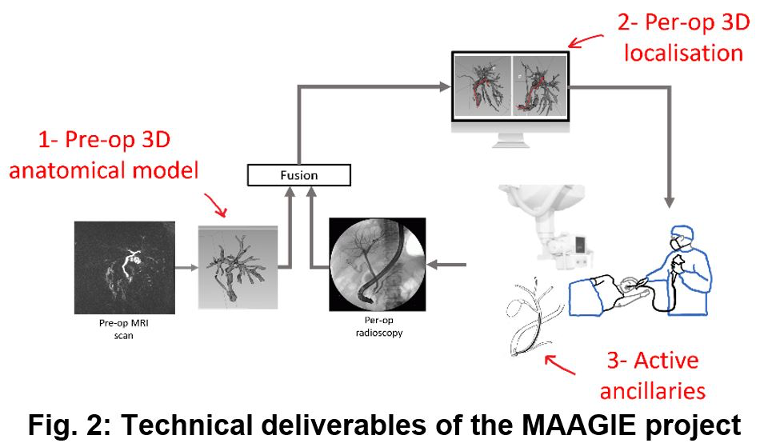
The objective of the MAAGIE project is to develop an integrated system for navigation and localization assistance during endoscopic retrograde cholangiopancreatography (ERCP) (Fig. 2). The ultimate goal is to improve the performance and safety of ERCP by significantly enhancing the operator’s situational awareness and operational capabilities. The future MAAGIE system will incorporate augmented visual feedback, enabling better preoperative planning and real-time instrument tracking during the procedure. The system will also feature active, robotic-assisted instruments to facilitate navigation within complex anatomy. Finally, physical models—derived from 3D reconstructions—will be developed to support training in the technical maneuvers required for ERCP.
Objectives
The MAAGIE system aims to provide three innovative features for performing complex ERCP (endoscopic retrograde cholangiopancreatography) procedures. These features, which fall under the category of computer-assisted ERCP, are as follows:
1- Automated 3D digital reconstructions of the biliary tract for pre-ERCP planning.
2- 3D/2D fusion and instrument localization, based on the 3D reconstructions, to provide augmented visual feedback during the ERCP.
3- New active instruments for ERCP, offering enhanced navigation capabilities.
The results
WP1: Regulatory aspects and clinical study.
WP1 established the regulatory framework for data collection, notably in collaboration with URC-Est (Saint-Antoine). A data management plan was drafted. The protocol for the retrospective study (outside the scope of the “Jardé” law) and the patient information sheet were finalized; the Henri-Mondor Institutional Review Board (IRB) issued a favorable opinion on October 2, 2026.
WP2: Preoperative planning and patient-specific 3D reconstruction.
The proposed automated segmentation relies on a 3D nnU-Net model, the augmentation of training data, and the incorporation of topological constraints. The latest results demonstrate accurate reconstruction in the majority of cases. Furthermore, we sought to leverage CT scans to perform hepatic volumetry based on the positioning of the main biliary branches and the Couinaud classification of liver segments.
WP3: Intraoperative instrument localization.
A localization program—designed to determine which biliary branch an ERCP instrument is located in, based on a single intraoperative X-ray image—has been finalized and tested retrospectively on approximately twenty cases. The software’s success rate for accurate localization is 85%, compared to 66% for the control group (11 experts external to the project).
WP4: Active instruments and remote actuation.
We focused on controlling the distal rotation of guidewires during procedures—a task that is highly problematic with current methods. An innovative device was designed and integrated into the catheter tip (3 mm in diameter). The ERCP (endoscopic retrograde cholangiopancreatography) simulator at ISIR was further developed, notably through the creation of new 3D-printed models of biliary tree structures. A testing campaign involving 4 experts external to the project confirmed the realism of the simulator.
Partnerships and collaborations
The MAAGIE project is funded by the ANR’s AAPG program. (Reference: ANR-24-CE19-6455)
The project partners are:
– ISIR – Sorbonne University – Jérôme Szewczyk, Aymeric Becq
Project lead; leader of WP0 (Organization) and WP4 (Active instruments and remote actuation)
– APHP – Saint-Antoine (Marine Camus) and Henri-Mondor (Aymeric Becq)
Leader of WP1 (Regulatory aspects and clinical study)
– BMBI – Compiègne University of Technology – Isabelle Claude, Jean-Matthieu Prot
Leader of WP2 (Preoperative planning and patient-specific 3D reconstruction)
– LIP6 – Sorbonne University – Isabelle Bloch, Andréa Pinna
Leader of WP3 (Intraoperative instrument localization)