Project: “Hearing the shape of an arena with spectral swarm robotics”
This project enables a swarm of simple robots, which can only perceive their immediate neighbours, to recognise the shape of the space in which they operate. It is based on the observation summarised by the Indian parable of the blind men and the elephant: as each one touches only one part of it, none can guess the animal’s shape. Similarly, each robot can only perceive its immediate neighbours. To overcome this limited perspective, the robots exchange data from one to the next, much like heat spreading: the speed at which these values become uniform depends on the shape of the arena and serves as its blueprint. This project arose from a collaboration between biophysicists at the University of Tokyo and robotics engineers at ISIR, and draws inspiration from a famous question in mathematical physics: ‘Can one hear the shape of a drum?’ (Mark Kac, 1966), with the aim of resolving a problem of collective perception.
The context
Swarm robotics draws inspiration from collective systems found in living organisms, such as ant colonies or schools of fish. It aims to enable large numbers of simple robots to cooperate using local rules. Research has already enabled these groups to coordinate their movements or form predefined patterns. However, they find it difficult to perceive the overall structure of their environment. This is because the small robots under study have limited memory and low computing power. They exchange messages over short distances without having the necessary equipment to observe the entire space or determine their position with precision. Conventional mapping techniques, which rely on sophisticated sensors and complex calculations, are therefore ill-suited to these machines. The challenge is to understand how a collective can access information that none of its members can obtain on their own. Geometry is particularly important, as narrow passages and obstacles alter both the movement of the robots and the flow of information.
Objectives
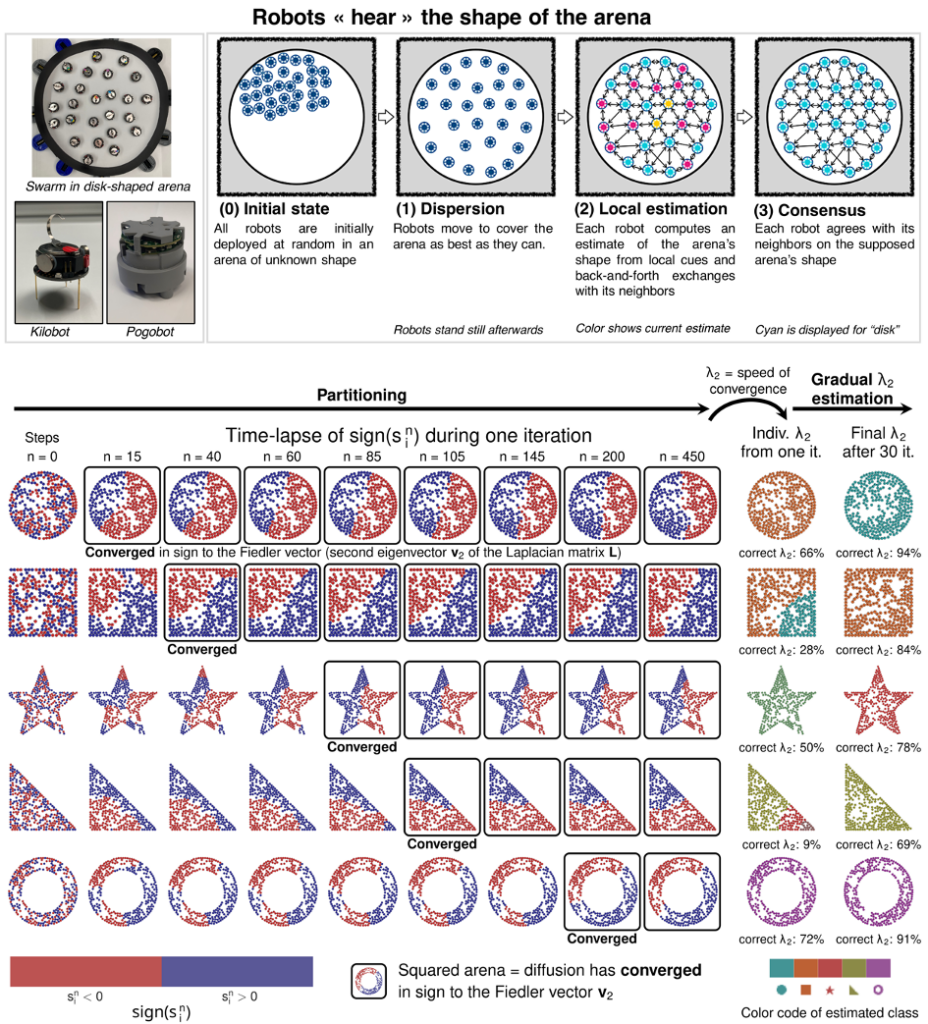
The main objective is to enable each robot to access information about the shape of the space occupied by the swarm without needing to know its own position, draw up a map or centralise the information on a computer. This approach involves making use of the way in which information flows within the group. Once distributed throughout the space, the robots exchange numbers representing virtual temperatures that change according to the rules of heat diffusion. The rate at which these differences even out should provide a ‘signature’ of the geometry, accessible to all. This signature is then compared with reference data to recognise a known shape. The research also examines the necessary conditions: how many robots are required, with what communication range, and for what area? Ultimately, the aim is to verify whether this collective perception remains possible with imperfect calculations and communications. The ambition is to make the network of interactions itself a tool for perception.
The results
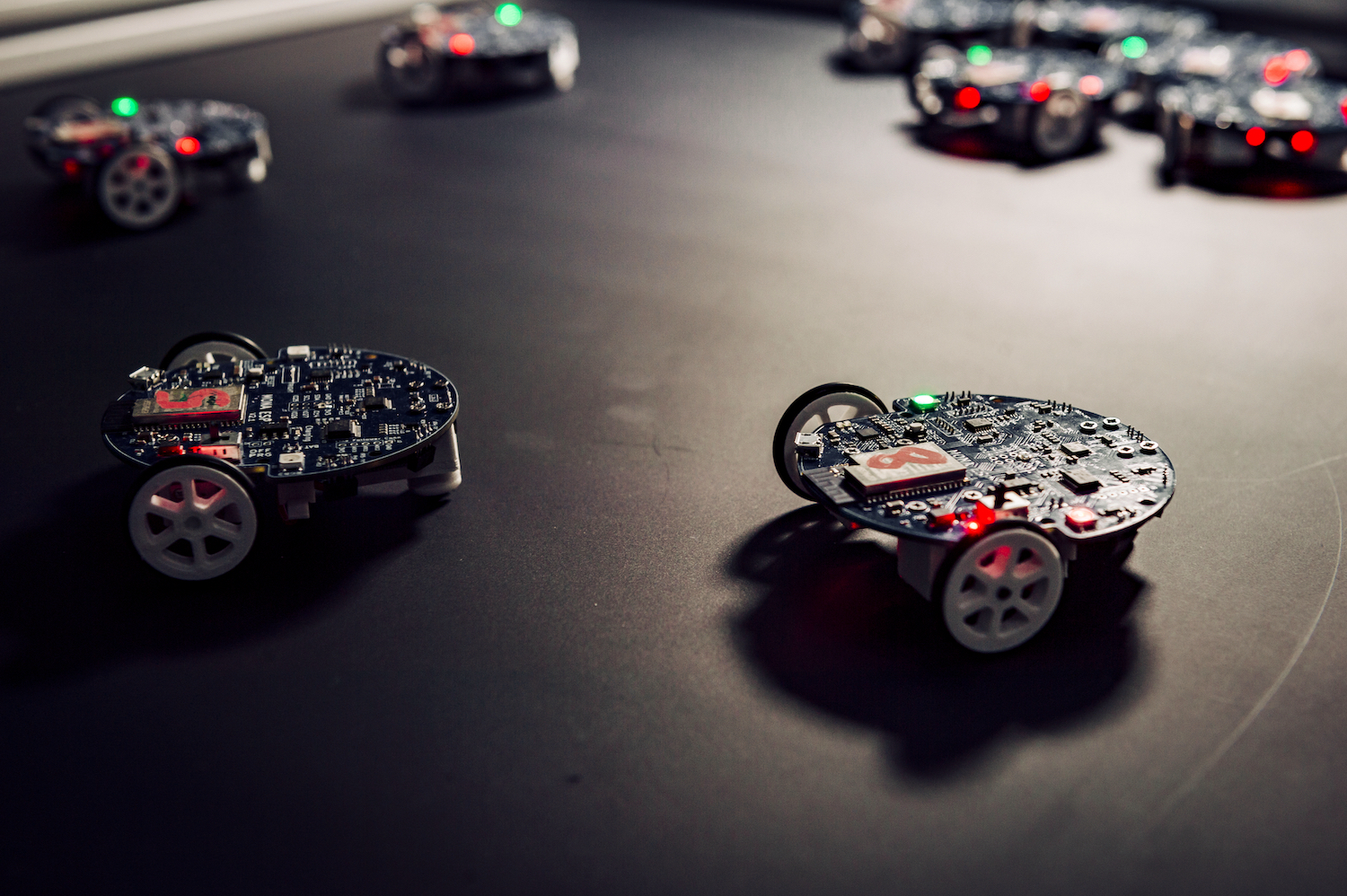
This method made it possible to distinguish seven shapes in simulation, with swarms of up to 550 robots. It has also been validated on two types of real robots: Kilobots and Pogobots. A swarm of 25 Pogobots was able to recognise whether its enclosure formed a disc or a ring in around five minutes per trial, across the 30 trials carried out. The researchers also established a relationship between the number of robots, the range of their communications and the area to be covered, in order to determine the most favourable configurations. These results show that a global property can be estimated by each robot through local exchanges and simple calculations. This approach could be extended to the recognition of a wider variety of shapes, the detection of cavities or boundaries, as well as to swarms in motion. Ultimately, this information could guide the deployment of robots or changes to their formation in order to adapt the group’s organisation to its environment. The communication network thus becomes a means of collective perception and computation.
Partnerships and collaborations
This interdisciplinary project drew on biophysics (University of Tokyo, Jean Perrin Laboratory at SU) and mathematics (Jean Monnet University, Saint-Étienne) to solve a problem in swarm robotics (ISIR, SU).