What if surgeons could access medical images without putting down their instruments or taking their eyes off the surgical field? This is the ambition behind the InteractOR project, which explores a new way of interacting with medical information during surgery. By using movements made with surgical instruments, this approach could facilitate access to preoperative data and enhance surgeons’ autonomy.
Bringing medical images closer to the surgical procedure
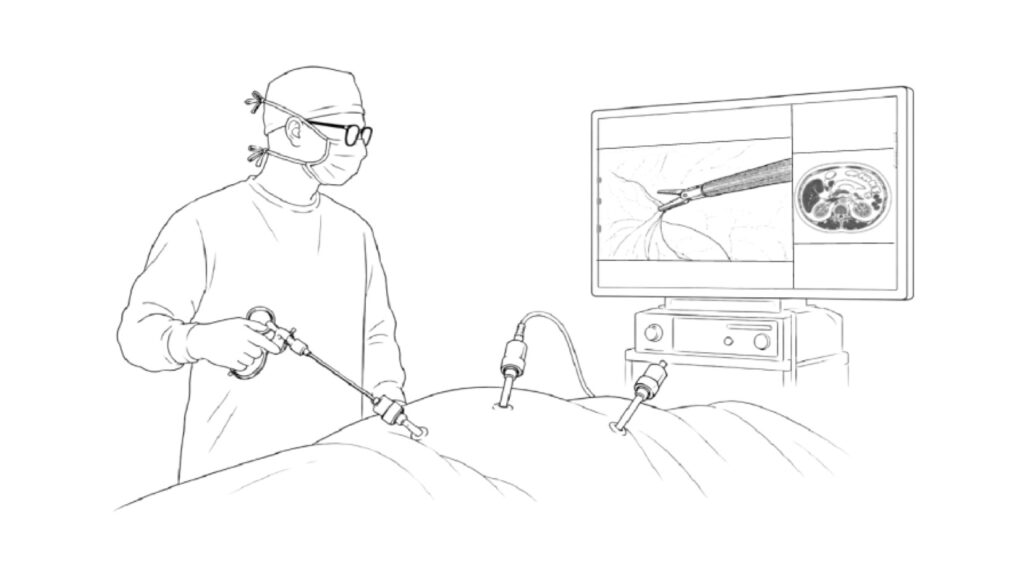
In minimally invasive surgery, surgeons work from video images transmitted by an endoscope. However, some information essential to the procedure, such as MRI scans taken before surgery, is generally viewed on a separate screen located outside the sterile field. To access it, surgeons must divert their attention, temporarily interrupt their activity, or ask a colleague to navigate through the images. The latter solution requires additional coordination and can lead to delays or misunderstandings.
Several devices already make it possible to control interfaces without physical contact, using voice commands, eye movements or gestures performed in the air. However, these solutions place additional demands on surgeons’ motor and attentional resources. To address these constraints, InteractOR explores a new paradigm: Interaction Through Instruments (ITI). Its principle is simple: to use the surgical instrument already held by the surgeon as a means of control, without modifying it or adding any sensors.
The idea, developed by Ignacio Avellino, CNRS Research Fellow at ISIR, is to bring access to medical information closer to surgical actions, while allowing surgeons to remain focused on their usual working environment.
Turning the surgical instrument into a control interface
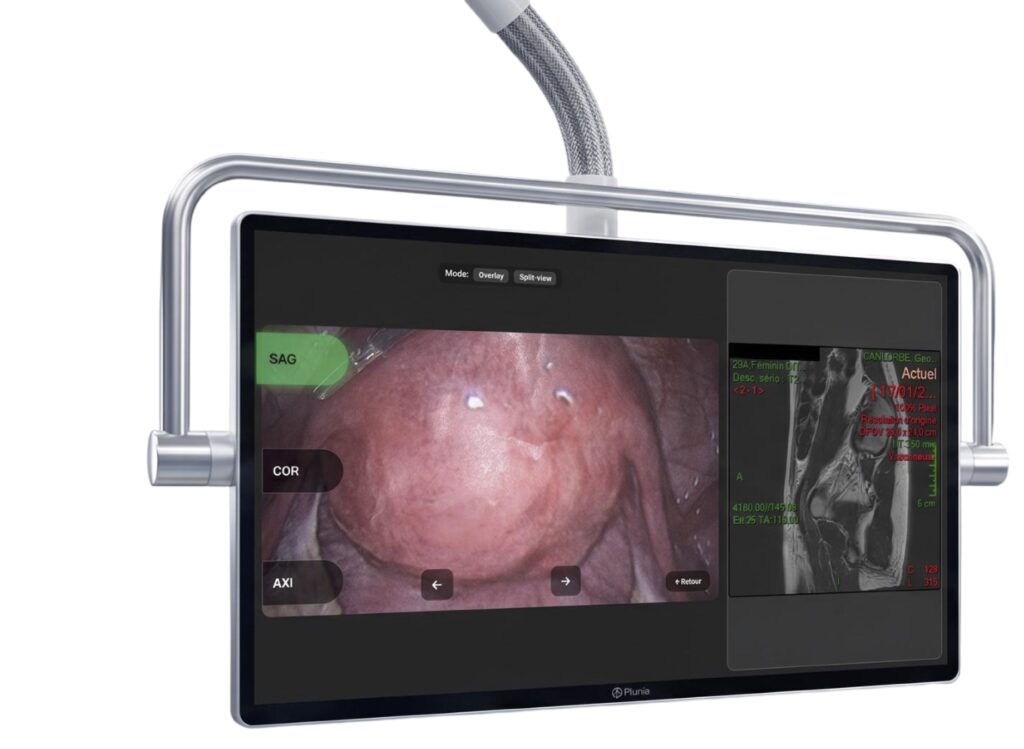
In practical terms, the system analyses the endoscopic video stream in real time to detect the surgical instrument and recognise some of its movements, particularly the pinching motion. These movements are interpreted as commands, allowing surgeons to select and browse preoperative medical images directly from the surgical view.
To design an interface suited to the realities of the operating room, the team first conducted observations of five laparoscopic procedures and a survey involving 23 surgeons. This work highlighted the diversity of information needs during surgery, particularly when consulting images and locating lesions. Five design workshops involving ten surgeons then helped identify suitable control gestures, display formats and safeguards to make this interaction understandable and safe.
Faster and autonomous access to medical images
An initial prototype was developed to enable surgeons to consult preoperative MRI images during a simulated surgical procedure. It detects the instrument in the endoscopic video and recognises the pinching motion to control the interface. Six surgeons successfully used the system on their very first attempt, providing an encouraging initial indication of its ease of use.
The team then evaluated the system in a simulated environment with 12 gynaecological surgeons. Two display formats were compared: medical images superimposed on the surgical view and a side-by-side presentation. With both configurations, surgeons reported feeling more autonomous and looked away from the surgical field less often than when asking a colleague to navigate through the images.
The time saving was also significant: locating the lesion took approximately one minute using the InteractOR interface, compared with two minutes when navigation was delegated to a colleague. The evaluations also showed that the side-by-side display required less mental effort. By contrast, superimposing images could obscure part of the surgical area.
Towards new possibilities for the operating room
Beyond MRI consultation, the paradigm developed through InteractOR could eventually be extended to other types of information useful during surgery, such as other medical examinations or data from patients’ medical records. These applications have yet to be explored and evaluated. The next step is to confirm the initial results under simulation conditions that more closely reflect clinical practice, in order to better assess the benefits and limitations of this interaction approach.
The project is being carried out at ISIR by Nour Karoui, Applied Scientist at Microsoft AI and former PhD student, alongside Ignacio Avellino, CNRS Research Fellow. It is co-supervised by Isabelle Bloch, Lecturer at LIP6, with support from Yara Ibrahim, PhD student, and Anaïs Seroul, Engineer, who recently joined the project.
The collaboration with the Assistance Publique – Hôpitaux de Paris (AP-HP) plays an essential role in this initiative. Surgeons have contributed to field observations, design workshops and system evaluations, ensuring that technological developments are aligned with the practical needs of healthcare professionals. InteractOR is funded by the French National Research Agency (ANR) as part of the TELEMENTOR project.
The project has also received recognition through the innovation competitions of the France 2030 programme. Nour Karoui, former PhD student at ISIR, was awarded the i-PhD Prize, which recognises young scientists seeking to translate their research into a business creation project. This distinction highlights the innovation and technology transfer potential of the research carried out as part of InteractOR.
By turning a conventional surgical instrument into a control interface without modifying it, InteractOR opens up an original approach to rethinking access to information in the operating room. This approach could help integrate digital tools more seamlessly into surgical practice, bringing information closer to the action itself.
Scientific contacts: Nour Karoui, Applied Scientist at Microsoft AI and former PhD student at ISIR, and Ignacio Avellino, CNRS Research Fellow at ISIR.
Published on 27/11/2026