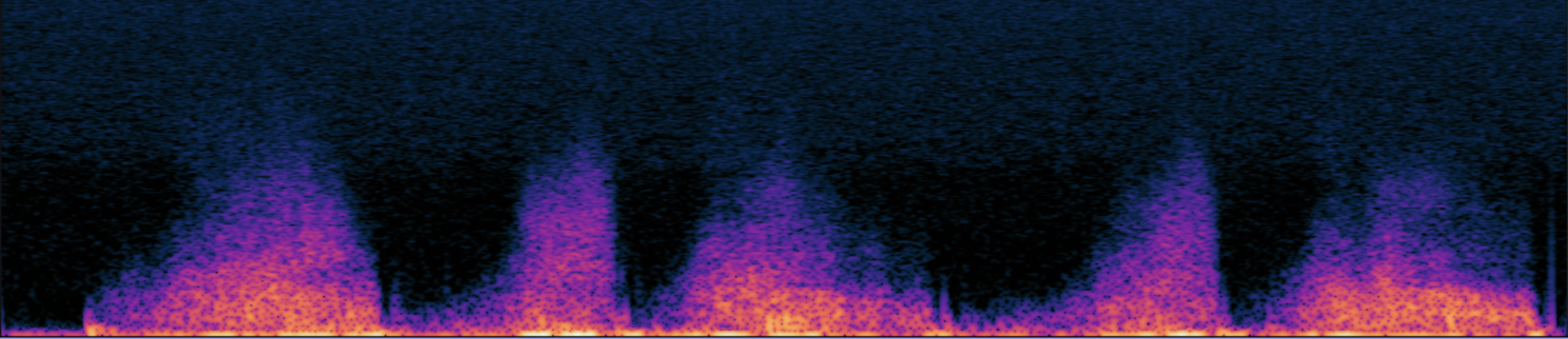
L’approche du projet Audio-touch combine les résultats de la recherche sur le toucher social et sur la sonification du mouvement, ce qui permet d’extraire certaines caractéristiques significatives des interactions tactiles et de les convertir en sons. Dans les études expérimentales du projet, les participant-es qui écoutaient les stimuli audio-touch peau à peau ont associé avec précision les sons à des gestes spécifiques et ont identifié de façon cohérente les intentions socio-émotionnelles sous-jacentes aux touchers convertis en sons.
De plus, les mêmes mouvements ont été enregistrés avec des objets inanimés, et des expériences supplémentaires ont révélé que la perception des participant-es était influencée par les surfaces impliquées dans les interactions tactiles (peau ou plastique). Cette approche audio-touch pourrait être un tremplin pour donner accès à l’expérience ineffable du toucher social à distance, avec des agents humains ou virtuels.
Le contexte
Le toucher est la première modalité sensorielle à se développer, et le toucher social a de nombreux effets bénéfiques sur le bien-être psychologique et physiologique des individus. Les situations de carences en touchers sociaux accentuent les sentiments d’isolement, d’anxiété et le besoin de lien social. Face à ce constat, il devient urgent d’explorer des moyens de recréer, à distance, les effets bénéfiques du toucher affectif.
Ce projet est né de cette urgence, mais aussi d’une observation fondamentale : le toucher et l’audition partagent une base physique commune, celle des vibrations. Les études de sonification ont déjà montré qu’il était possible de traduire des mouvements et leurs propriétés en sons. Il devient alors envisageable de traduire certaines caractéristiques des interactions peau à peau en signaux auditifs perceptibles. De la convergence entre ce besoin de lien tactile à distance et les similitudes physiques entre toucher et son est né le projet Audio-touch, qui vise à transmettre les informations du toucher affectif via des sons.
Les objectifs
L’objectif principal de cette recherche est d’étudier les possibilités offertes par l’audio-touch : peut-on convertir du toucher peau à peau en sons ? Plus précisément, l’équipe a ensuite déterminé expérimentalement quelles informations du toucher social les stimuli audio-touch pouvaient communiquer aux personnes qui les écoutent : peut-on reconnaître différents types de gestes du toucher dans nos stimuli audio-touch ? peut-on reconnaître différentes intentions socio-affectives sous-jacentes à ces gestes du toucher sonifié ? la surface sur laquelle le toucher a lieu (peau versus objet inanimé) influence-t-elle ces perceptions ?
Les résultats
Les quatre expériences menées dans cette étude montrent que les gestes tactiles sociaux, leurs intentions socio-émotionnelles et la surface touchée (peau vs plastique) peuvent être reconnus uniquement à partir des sons audio-touch créés. En effet, les résultats montrent que :
– les participant-es ont correctement catégorisé les gestes (expérience 1),
– les participant-es ont identifié les émotions transmises (expérience 2),
– leur reconnaissance a été influencée selon la surface sur laquelle le toucher avait lieu (expériences 3 et 4).
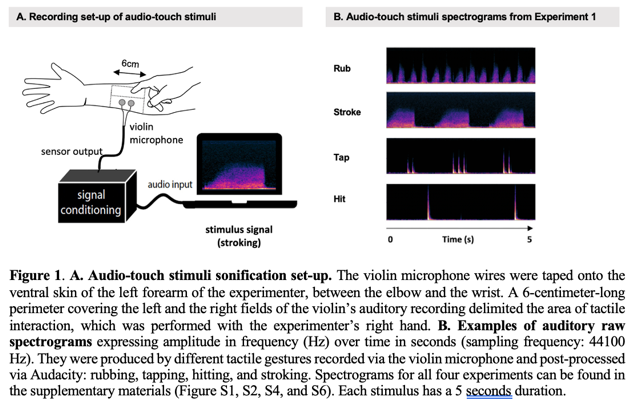
Ces résultats ouvrent des perspectives à l’intersection des domaines de l’haptique et de l’acoustique, le projet Audio-touch se situant précisément à la croisée de ces deux champs, tant par sa méthodologie de captation des gestes tactiles que par son intérêt pour la perception humaine des signaux sonores issus du toucher. Ils s’inscrivent également dans les recherches en interaction humain-machine, et suggèrent que des sons issus du toucher social pourraient enrichir les expériences multisensorielles, notamment dans les interactions avec des agents sociaux virtuels.
Partenariats et collaborations
Le projet est une collaboration entre :
– Alexandra de Lagarde, doctorante de l’équipe ACIDE de l’ISIR,
– Catherine Pelachaud, directrice de recherche CNRS de l’équipe ACIDE de l’ISIR,
– Louise P. Kirsch, maîtresse de conférence INCC, à l’Université Paris Cité, et ancienne post-doctorante de l’équipe Piros à l’ISIR,
– Malika Auvray, directrice de recherche CNRS de l’équipe ACIDE de l’ISIR.
De plus, pour la partie acoustique liée au projet, l’étude a bénéficié de l’expertise de Sylvain Argentieri pour la partie enregistrements et de Mohamed Chetouani pour la partie traitement du signal.
Il s’inscrit également dans le cadre du programme ANR MATCH, qui explore la perception du toucher dans les interactions avec des agents virtuels, en partenariat avec HEUDIASYC (UTC) et le LISN (Université Paris Saclay).
The Audio-touch project approach combines the results of research into social touch and the sonification of movement, making it possible to extract certain significant features from tactile interactions and convert them into sounds. In the project’s experimental studies, participants listening to skin-to-skin audio-touch stimuli accurately associated the sounds with specific gestures and consistently identified the socio-emotional intentions underlying the touches converted into sounds.
In addition, the same movements were recorded with inanimate objects, and further experiments revealed that participants’ perception was influenced by the surfaces involved in tactile interactions (skin or plastic). This audio-touch approach could be a springboard for providing access to the ineffable experience of social touch at a distance, with human or virtual agents.
The context
Touch is the first sensory modality to develop, and social touch has many beneficial effects on the psychological and physiological well-being of individuals. The lack of social touch accentuates feelings of isolation, anxiety and the need for social contact. Given this situation, there is an urgent need to explore ways of recreating the beneficial effects of emotional touch from a distance.
This project was born of this urgency, but also of a fundamental observation: touch and hearing share a common physical basis, that of vibrations. Sonification studies have already shown that it is possible to translate movements and their properties into sounds. It is therefore conceivable to translate certain characteristics of skin-to-skin interactions into perceptible auditory signals. The convergence of this need for a tactile link at a distance and the physical similarities between touch and sound has given rise to the Audio-touch project, which aims to transmit the information of affective touch via sound.
Objectives
The main objective of this research is to study the possibilities offered by audio-touch: can we convert skin-to-skin touch into sound? More specifically, the team then experimentally determined what social touch information the audio-touch stimuli could communicate to the people listening to them: can we recognise different types of touch gestures in our audio-touch stimuli? can we recognise different socio-affective intentions underlying these sonified touch gestures? does the surface on which the touch takes place (skin versus inanimate object) influence these perceptions?
The results
The four experiments conducted in this study show that social tactile gestures, their socio-emotional intentions and the surface touched (skin vs plastic) can be recognised solely from the audio-touch sounds created. The results show that :
– the participants correctly categorised the gestures (experiment 1),
– participants identified the emotions conveyed (experiment 2),
– their recognition was influenced by the surface on which the touch took place (experiments 3 and 4).
These results open up new perspectives at the intersection of the fields of haptics and acoustics, with the Audio-touch project situated precisely at the crossroads of these two fields, both in terms of its methodology for capturing tactile gestures and its interest in the human perception of sound signals derived from touch. They are also in line with research into human-computer interaction, and suggest that sounds derived from social touch could enrich multisensory experiences, particularly in interactions with virtual social agents.
Partnerships and collaborations
The project is a collaboration between :
– Alexandra de Lagarde, PhD student in the ACIDE team at ISIR,
– Catherine Pelachaud, CNRS research director in the ACIDE team at ISIR,
– Louise P. Kirsch, lecturer at Université Paris Cité, and former post-doctoral student in the Piros team at ISIR,
– Malika Auvray, CNRS research director in the ACIDE team at ISIR.
In addition, for the acoustic aspects of the project, the study benefited from the expertise of Sylvain Argentieri for the recordings and Mohamed Chetouani for the signal processing.
It is also part of the ANR MATCH programme, which explores the perception of touch in interactions with virtual agents, in partnership with HEUDIASYC (UTC) and LISN (Université Paris Saclay).