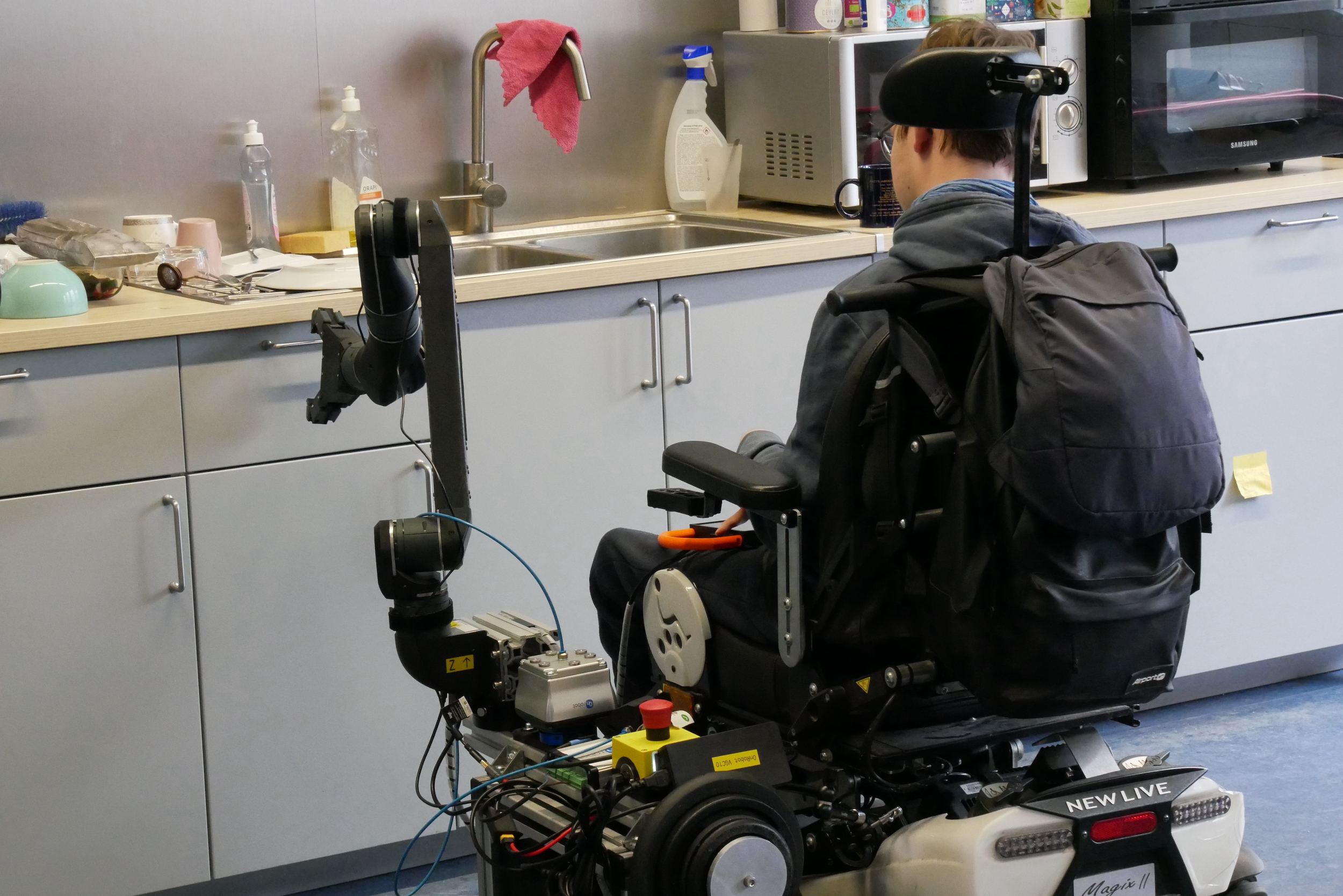
Assistive robotic arms are designed to offer their users new motor capabilities. These devices, which can be fitted to electric wheelchairs used by people with disabilities, enable them to manipulate objects or interact with their environment through voluntary control.
A research project at the interface of robotics, human movement sciences and the socio-anthropology of technology proposes to further the study of these systems by developing the concept of “perimanipulation”.
The aim is to gain a better understanding of the specific characteristics of robots operating in the immediate vicinity of their operators and to design modes of interaction suited to this particular situation.
From tele-manipulation to perimanipulation
This work builds on research carried out over several decades in the field of tele-manipulation, where an operator remotely controls a robot operating in a different environment. These technologies have led to major applications, particularly in the medical field with robotic surgery systems. The da Vinci surgical system, capable of remotely replicating a surgeon’s movements with remarkable precision, perfectly illustrates this development.
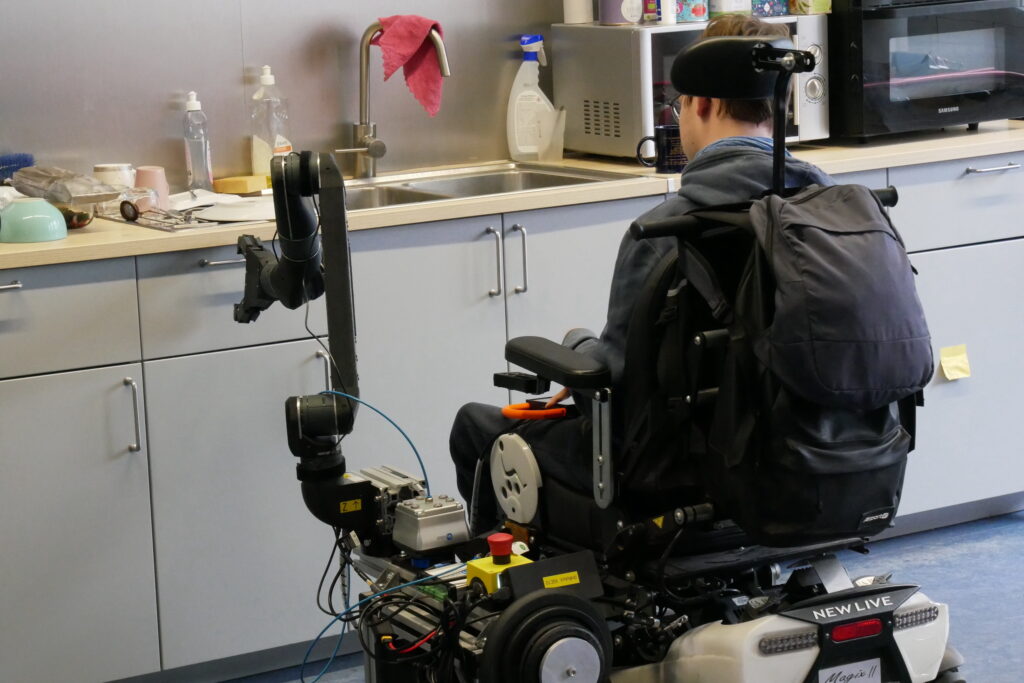
Perimanipulation, however, differs from conventional tele-manipulation in the proximity between the user and the robot. The device operates in the immediate vicinity of the person controlling it, with whom it shares the same environment. This configuration alters the ways in which perception, action and control take place. It also raises questions regarding users’ familiarity with the device, its integration into daily activities, and the relationships that develop between the person, the technology and their environment.
Despite the growing development of these assistive devices, these issues remain largely unexplored as a distinct area of research in their own right.
Developing control methods tailored to each individual’s abilities
The project’s first area of research focuses on control interfaces and sensorimotor couplings between the user and the robot.
The teams will investigate various control methods suited to the diversity of disability situations: joysticks, switches operated by a part of the body, touchscreens, sensory feedback devices and even eye-tracking. The latter represents a significant challenge for some people whose motor abilities are severely limited.
The work will build on findings already obtained in the field of robotic prosthetics, which have shown that it is possible to estimate a user’s objectives based on the motor compensations they naturally employ to achieve a goal. This knowledge will be utilised to develop more intuitive and customisable control systems.
Making handling easier through shared control
The second focus of the project concerns shared control between the user and the robot.
The idea is to utilise information provided by sensors and cameras to help the robot interpret the context of the task. If an object is identified, the system could, for example, adapt certain movements according to its geometric characteristics. Following this logic, the user would no longer simply control the robot’s movements, but would interact more directly with the object they are seeking to handle.
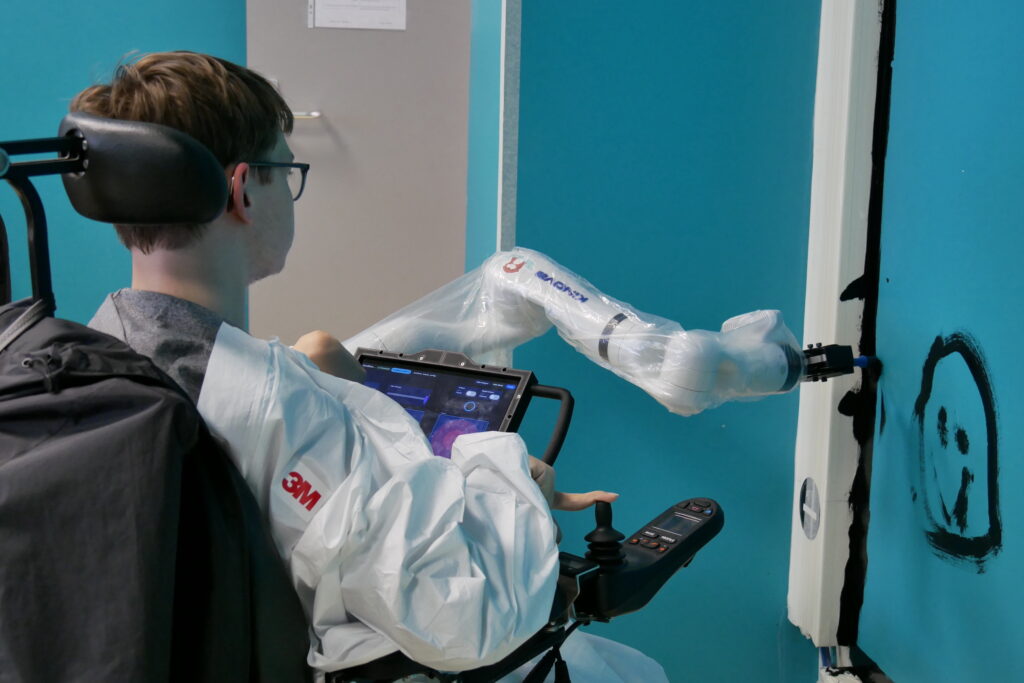
The teams will also be working on managing physical interactions with the environment. Opening a door is a typical example: the robot must not only apply the appropriate force, but also take into account the mechanical constraints imposed by the door’s movement. This work aims to make manipulations smoother and safer in everyday situations.
Involving users from the design stage
Another unique feature of the project is that it places actual usage at the heart of the research process. People with disabilities will not only be consulted during the evaluation phases, but will also be involved in discussions about the needs, uses and future development of the devices.
This approach draws in particular on the Paris Cybathlétique Club, inspired by the international Cybathlon competition, which brings together people with disabilities who use assistive technologies. This framework will enable the testing of new uses in sporting, recreational or artistic contexts.
The project will also involve medical teams specialising in physical and rehabilitation medicine, sociologists specialising in usage patterns, and artists. These collaborations will enable the study of both the functional performance of the devices and their place in users’ everyday lives.
Expected benefits for independence and inclusion
The project’s findings are intended to be incorporated into the Explorer robotic arm developed by the French company Orthopus, a partner in the Extender project for the past two years, which has helped to better define the various research questions addressed in the “Périmanipulation” project. They may also contribute to the development of new design and control methods for assistive devices.
Beyond the expected scientific advances, the research aims to improve the user experience of robotic arms designed for people with disabilities, taking into account technical challenges, real-world usage and users’ expectations.
By bringing together robotics engineers, human movement specialists, sociologists, healthcare professionals and users, the project thus aims to contribute to the development of assistive technologies that are better suited to the needs of the people who use them on a daily basis.
En réunissant roboticiens et roboticiennes, spécialistes du mouvement humain, sociologues, professionnels et professionnelles de santé, et usagers, le projet entend ainsi contribuer au développement de technologies d’assistance mieux adaptées aux besoins des personnes qui les utilisent au quotidien.
As part of this project focusing on perimanipulation, Guillaume Morel, university professor, robotics researcher at ISIR and project leader, has been appointed a member of the Institut Universitaire de France (IUF) with effect from 1 October 2026, for a term of five years. Awarded an Innovation Chair, this distinction recognises the originality of his work at the interface between robotics, human movement sciences, and the humanities and social sciences.
Scientific contact: Guillaume Morel, University Professor
Published on 29/07/2026